Grilling season: How to enjoy BBQ and reduce cancer risks
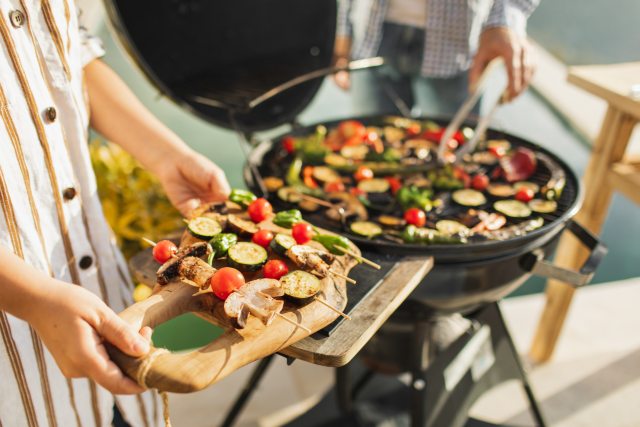
Give veggies a chance to shine at your next cookout
When summertime rolls around, you might enjoy outdoor cooking.
But there’s a caveat. Research shows that eating well-done, fried or barbecued meats can put you at higher risk for colorectal, pancreatic and prostate cancers.
With a few simple changes, you can still enjoy your grill and lower your cancer risks, according to Cecelia Jacobson, RD, a dietitian at PeaceHealth in Springfield, Oregon.
How grilling increases cancer-causing compounds in food
When grilled at high temperature, meats such as beef, pork, poultry and fish produce two cancer-causing compounds: HCAs (heterocyclic amines) and PAHs (polycyclic aromatic hydrocarbons.) In laboratory experiments, both of these compounds have been found to cause changes in DNA that may increase the risk of cancer.
HCAs are produced when meat reacts at high temperatures (greater than 300 degrees Fahrenheit). HCAs begin to form at the low end of that temperature range and build up during prolonged cooking. At the high end of that range, HCAs begin to form within minutes.
PAHs form when fat from the meat drips onto hot coals or stones and then coats the meat through smoke and flare-ups.
Simple changes to lower cancer risks of grilled foods
To get the best out of grilling and lower your cancer risks, Jacobson offers these tips:
1. Make produce the star at your barbecue.
Unlike meat, vegetables don’t form HCAs when grilled. And there’s typically little fat to drip and create PAHs. Plus fruits and vegetables are high in antioxidants and can help protect against cancer.
Try grilling corn on the cob or skewered tomatoes, peppers and zucchini to add color and flavor to your meal. Grilled fruits, such as pineapple or peaches can add a sweet treat to a meal.
2. Avoid directly exposing meat to open flames or to a hot metal surface.
The black, crispy crust you see on the edge of ribs or a steak is more likely to contain a higher concentration of potentially carcinogenic compounds.
Cut off the charred sections or limit the amount you eat.
3. Avoid prolonged cooking time, especially at high temperature.
That will help reduce the build-up of HCAs and PAHs.
The longer the meat cooks, the longer the chemical reaction is happening to create more HCAs.
Consider partially cooking your meat in the oven, then finish it off on the grill. Another option is to grill the meat in foil to protect it from smoke and also speed up cooking time.
4. Continuously turn the meat as it cooks.
Show gratitude to the grill masters who stand at the barbecue, patiently flipping steaks and burgers and turning hot dogs. Their work is not in vain.
Continuously turning meat over a high heat source can substantially reduce the formation of HCAs compared with just leaving the meat on the grill.